
Hot Topics in Skin Cancer: Proton Therapy and Immunotherapy, Mohs and Radiation
June 9, 2026
As the mercury rises in summer, so should awareness of skin cancer, the most common cancer type. More people develop skin cancer each year in the U.S. than all other cancer types combined – about one in five adults develop some type of skin cancer before the age of 70, and about 9,500 people in the U.S. are diagnosed with skin cancer every day.
Whether patients are diagnosed with melanoma, the most common non-melanoma cancers, squamous cell or basal cell carcinoma, or rarer cancers like Merkel cell carcinoma, proton therapy could hold advantages over other therapy types. As we head into warmer weather, read on for some hot topics in skin cancer.
Skin Cancers on the Head and Neck: Mohs and Proton Therapy
Skin cancers frequently develop in the head and neck area since these areas are typically sun-exposed when people are outside. In fact, skin cancers are a little more common on the left side just from sun coming through the window while driving! Cosmetic outcomes of skin cancer treatment are especially critical and a concern for patients in these areas, as well. These regions also contain a plethora of vulnerable anatomy – including the eyes, nose, lacrimal and salivary glands, mouth/teeth, and even the brain and spinal cord.
Surgical techniques such as Mohs are the most common way to treat skin cancers, offering a “one and done” procedure that’s often curative. Mohs is a fantastic technique and the right option in many cases; however, it can sometimes leave a substantial cosmetic change to the area in the process of eradicating the cancer. Performing this procedure in tight areas, such as the nose or ear, may require removal of substantial portions of these structures, necessitating reconstruction to minimize cosmetic effects.

Dr. Matthew J. Ferris
Medical Director, Maryland Proton Treatment Center; Associate Professor of Radiation Oncology
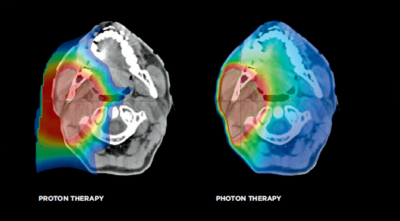
Image comparison of proton therapy vs. photon therapy
In these cases, primary radiation might be a better choice, with cure rates for small cancers on par with surgery. Proton beam therapy can provide precise dosing while shaping to the complex contours of the head and neck region– targeting the cancer while avoiding underlying or adjacent anatomy often better than what can be accomplished by other radiation techniques (electrons, photons, etc). Proton beam therapy can also be used after Mohs to help further sterilize the area from cancer cells, for higher-risk cases which need more help beyond just Mohs alone. Proton beam therapy is a really valuable tool in the skin cancer treatment arsenal, and can generally be considered anytime radiation might be employed.
Combining Proton Therapy with Immunotherapy
Checkpoint inhibitors have been a game-changing therapy for melanoma, famously extending former president Jimmy Carter’s survival for nearly a decade after he was diagnosed with advanced melanoma in 2015. Melanoma is a particularly immunologically “hot” tumor, and tends to respond exceptionally well to immunotherapy. Increasingly, though, immunotherapy has been used for other cancer types, and now this includes non-melanoma skin cancers. More and more, we appreciate that non-melanoma skin cancers are not just a product of chronic sun exposure, but also of the waning immune system strength that happens with age.
Cemiplimab and pembrolizumab have both been approved immunotherapy options for metastatic cutaneous squamous cell carcinoma. But now we are able to shift immunotherapy earlier in the disease process, and potentially help with cure rates for cases that are advanced but not yet metastatic. A New England Journal of Medicine study published in May 2025 showed that cemiplimab – a checkpoint inhibitor that targets PD-1 – significantly extends disease-free survival in patients with high-risk squamous cell carcinoma who underwent surgery and postoperative radiation.
When patients receive a combination of immunotherapy and radiation, the effects can be synergistic: As cells die from radiation exposure, they release antigens into the circulation that prompt the immune system to recognize and fight tumors, a phenomenon enhanced by immunotherapy drugs. Thus, proton therapy and other forms of radiation could boost the effects of immunotherapy, more effectively treating patients with skin cancer and other cancer types.