
The Case for Proton Therapy in Lung Cancer Care
April 22, 2026
Progress in Treating Lung Cancer, But Challenges Persist
Several innovations over the past few years have revolutionized the way we treat lung cancer. For example, minimally invasive surgical techniques have reduced the recovery times associated with open surgeries and helped patients heal faster; immune checkpoint inhibitors have nearly doubled survival rates for some types of advanced disease. However, even with this progress, lung cancer – the third most common cancer in the U.S. – remains the deadliest cancer type. This year, the American Cancer Society projects that nearly 125,000 people will die from this disease, almost as much as colorectal, breast, and prostate cancers combined.
Like most cancers, surgery, chemotherapy, and radiation — or a combination of the three — may be recommended for management of lung cancer. Many patients are former smokers, and as a result might not have lungs fit enough for surgery to be a part of their care. These patients in particular, with less pulmonary reserve, may be exceptional candidates for proton therapy to be used for their radiation treatments.

Dr. Matthew Ferris
Medical Director, Maryland Proton Treatment Center; Associate Professor of Radiation Oncology
The Advantage of Precision Radiation for Lung Cancer
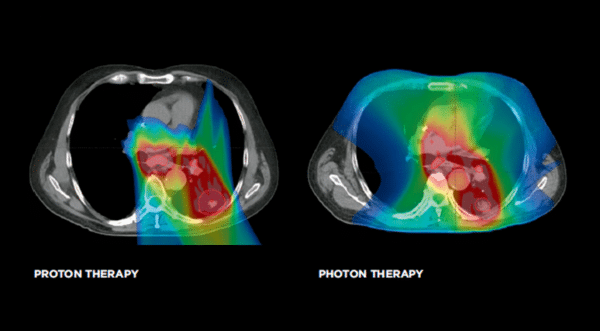
Proton therapy can hold significant advantages over photon therapy for certain lung cancer patients. Modern pencil beam scanning proton therapy offers with respect to giving less dose compared to traditional photon radiation to the esophagus, spinal cord, lungs, and heart for patients receiving chemotherapy and radiation together as curative treatment for lung cancer. This likely translates into fewer side effects during treatment, and randomized clinical trials are ongoing to prove this definitively. Precursor studies, including large single and multi-institutional experiences, have been promising. For example, one large study demonstrated that proton therapy is associated with significantly less risk of lung inflammation (pneumonitis) and cardiac events (such as myocardial infarction, arrhythmias and pericarditis) compared to traditional photon therapy.
In addition, proton therapy reduces the radiation dose received by the spinal cord, potentially decreasing the risk of radiation-induced myelitis and nerve damage, while allowing for improved ability to re-treat areas in the chest with radiation in the future if needed. Proton therapy also helps mitigate dose to the circulating blood and immune system, helping patients’ blood counts remain in normal ranges and allowing their immune systems to hold strong during treatments – potentially making patients more likely to receive immunotherapy and for immunotherapy to be more effective.
Which Patients Benefit Most from Protons?
Although proton therapy can be appropriate for any lung cancer patient who’s prescribed radiation as part of their treatment protocol, some patients may benefit more than others. For example, those with locally advanced disease, unresectable disease, very large tumors, tumors located centrally to the chest, or with lymph node involvement could be particularly good candidates for this modality. Proton therapy can often allow for reirradiation in patients with recurrent disease.
A Multidisciplinary Approach to Personalized Care
The Maryland Proton Treatment Center houses a multidisciplinary thoracic oncology clinic where lung cancer patients can come to receive opinions from a variety of specialists. Experts here can help patients decide whether proton therapy is the right fit for each individual case. As one of the oldest and most experienced centers in the U.S. with pencil beam scanning technology, we’re helping boost outcomes for lung and other thoracic cancers.