
When Targeted Radiation Matters More: Proton Therapy for Younger Breast Cancer Patients
October 21, 2026
Between 2012 and 2021, invasive breast cancer incidence increased by approximately 1% annually, with a more pronounced rise among women younger than 50 (1.4% per year). This trend may partly reflect changing reproductive patterns, including lower parity and delayed childbearing, as well as shifts in the prevalence of established risk factors.
Why Age Matters in Radiation Treatment
Radiation is a typical part of the treatment regimen for many of these patients and has both short- and long-term side effects. For younger women, the long-term side effects can be more impactful due to the extended time they’ll typically live with them. Although many of these side effects are unavoidable, treating patients with proton therapy, rather than conventional photon therapy, can mitigate their severity and reduce future risks. Because intensity modulated proton therapy (IMPT) is more targeted than conventional radiation and has no exit dose, it can significantly diminish the risk of collateral damage to nearby structures.
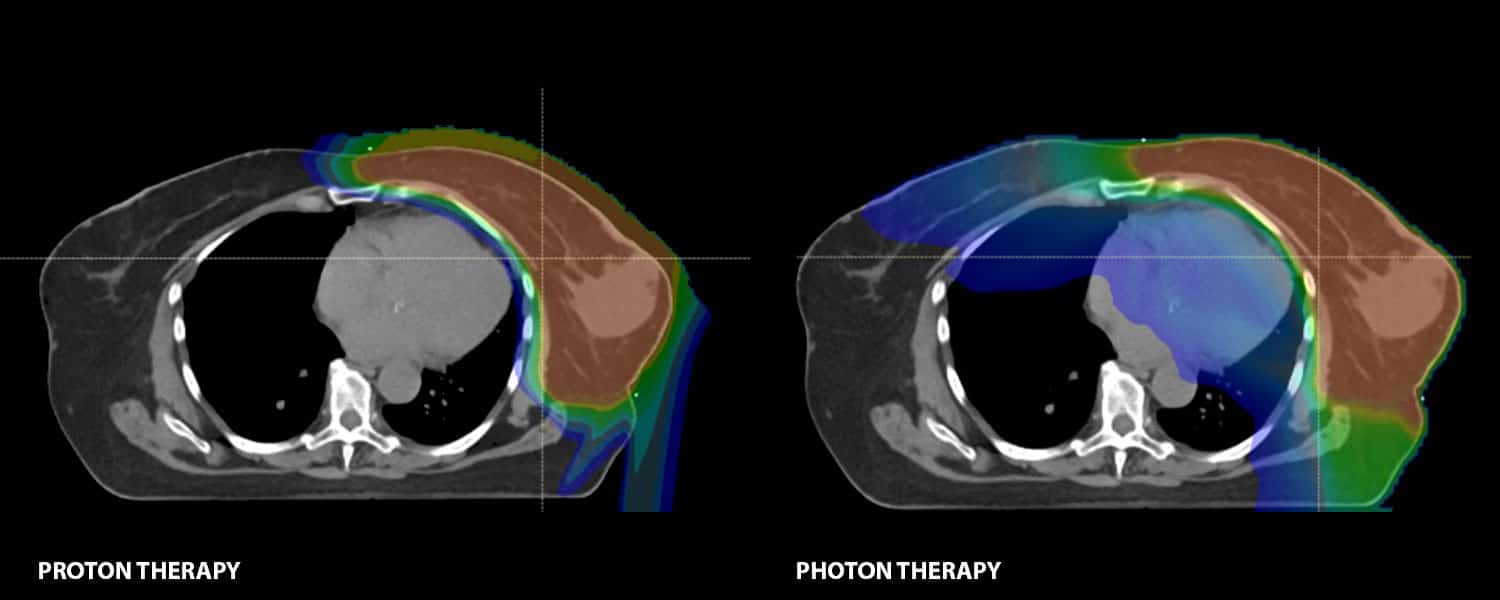
Scan comparison of proton therapy and photon therapy.

Dr. Elizabeth Nichols, MD
Vice Chair of Clinical Affairs, Professor of Radiation Oncology, University of Maryland School of Medicine
Protecting the Heart During Breast Cancer Treatment
This is especially important for treating tumors that occur in the left breast, where radiation treatment can affect the heart. Studies have shown the higher the dose of radiation received to the heart, the higher the risks. Several treatment modalities commonly used for breast cancer can independently increase heart disease risk—for example, some chemotherapy agents can cause cardiotoxicity, and hormone blockers for estrogen receptor-positive cancers can increase weight and cholesterol levels.

Conventional radiation therapy, both alone and in conjunction with these treatments, can further increase that risk by spurring inflammation in the heart muscle and associated blood vessels. This inflammation can weaken the heart and promote the development of atherosclerotic plaques that lead to coronary heart disease over time. Because the radiation dose of IMPT is significantly more targeted, these structures are spared, reducing breast cancer survivors’ risk of eventually developing heart disease. If we know patients have existing cardiac issues or risks—for example, those taking HER2 inhibitors are more likely to develop valve dysfunction—IMPT may be an even more important consideration.
Reducing Exposure to the Lungs and Lymphatic System
Although only about 1-2% of breast cancer patients develop lung issues from radiation exposure, this risk is heightened for smokers, making IMPT a good choice in this population as well. Because of the targeted nature of IMPT, it helps spare nearby lymphatic tissue, which can lower the risk of developing lymphedema. The risk of developing lymphedema is high even without radiation, affecting about 1 in 5 patients and up to half who undergo resection of 10 or more axillary lymph nodes, with radiation further increasing these numbers.
IMPT may also have advantages for patients who have already received radiation in the thoracic region to treat prior cancers. Because radiation-induced damage to collateral structures accumulates with each exposure, proton therapy’s targeted nature can lower a patient’s total lifetime dose to these areas.
Lowering Lifetime Risk
While the risk of developing secondary malignancies from radiation for breast cancer is low—only about 3% of secondary cancers have been directly attributed to radiation exposure for breast cancer—it’s still an important factor to consider, especially for patients with genetic mutations predisposing them to developing cancers, such as a BRCA mutation as well as women receiving radiation under the age of 40. Numerous studies have suggested that the risk of secondary malignancies is inversely correlated with the age of the patient when they receive radiation treatment.
If you feel your patients could benefit from proton therapy, MPTC physicians are available to discuss their cases. Particularly for younger patients, proton therapy can help give women the best chance for a healthy future.